
Holidays to Switzerland Travel Podcast Episode 175 Transcript
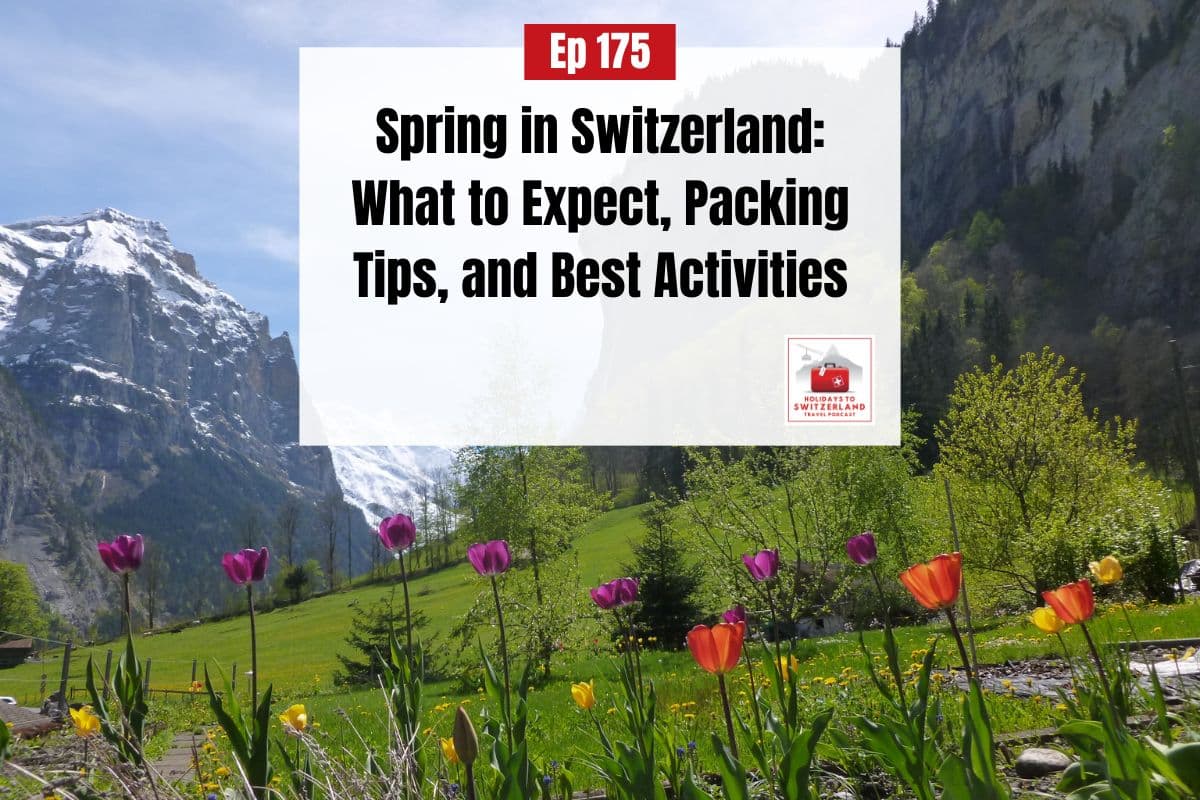
Spring in Switzerland: What to Expect, Packing Tips, and Best Activities
You can see the full show notes and listen to this episode > here.
Carolyn Schönafinger: Welcome to the Holidays to Switzerland podcast. If you’re planning a trip to Switzerland, this is the podcast for you. I’m your host, Carolyn Schönafinger, the founder of holidays to Switzerland.com and in each episode, my expert guests and I share practical tips to help you plan your dream trip to Switzerland. You’ll get helpful advice about travelling around Switzerland and hear about the most popular destinations, as well as some hidden gems, and we’ll introduce you to plenty of wonderful experiences that you can enjoy as part of your Swiss vacation. Each episode is packed with expert tips, itinerary ideas, and inspiration to help make your Swiss vacation planning easy. So, let’s dive in. Hello and welcome to this week’s episode. If you’re planning a trip to Switzerland in spring, or you’re wondering whether spring is actually a good time to visit, then today’s episode is for you. A spring vacation appeals to many travellers, particularly those who want to avoid the peak season crowds. But there are some important things to know if you are planning to visit Switzerland during the spring. Today, I’m joined by Tanya Deans, who has lived in Switzerland for over 20 years and knows the country well.
Carolyn Schönafinger: As a local, Tanya gets to experience Switzerland in all seasons, and she’s got some great tips and insight about visiting in spring to share with us today. Hi, Tania. Welcome back to the podcast. It’s lovely to have you here chatting with me again today. For the folks who haven’t heard you on a previous episode, could you introduce yourself to all our listeners?
Tanya Deans: Great to be here. I’m Tanya Deans. I run Swiss Family Fun. It’s a website where we, I write about hiking in Switzerland, particularly for families and casual hikers and, you know, people who are either living in Switzerland or, travelling to Switzerland. In here 20 years. I originally from California and I started the website to help share tips about going out in English back when there weren’t so many resources and now it’s become my whole business. And I have a lot of fans here in Switzerland that I meet on the trail sometimes, which is kind of fun, but I’m always gathering information from other families and other people that are travelling here to see what they like, and then I’m distilling that into the advice I give on the site. So I have two kids. I raised them here, and now they’re 18 and 21. We became citizens about 10 years ago, so this is our home.
Carolyn Schönafinger: Fantastic. And what a fantastic place to call home, it would be. Now, the reason I asked you to come back onto the podcast today is to get all your local insider knowledge, because I know that for many people, when they’re choosing what time of year they should visit Switzerland, it can be pretty difficult. And if they’re not tied to specific dates, they might think spring sounds like a great time to visit. But I’m sure like any season, there’s probably pros and cons. So can you tell us, in your opinion, is spring a good time to visit Switzerland?
Tanya Deans: Spring can be nice, but I would say it’s not ideal. I know a lot of people want to come in spring because they have spring breaks from school, or they want to avoid the high tourist season. But spring can be a really tricky time in Switzerland because really our summer season doesn’t start until about mid June. And so when you come in spring, you have to be really careful about what activities that you choose. So when you have this wish list of all these beautiful places you want to visit in Switzerland that you’ve seen from social media, and then you come in the spring, we don’t really have that lush summer look yet. A lot of the trees don’t have their leaves yet. Landscape can look a little bit dead. So you have to really be picky. Plus the mountains, they have a lot of snow even up until July at the higher elevations. So if you pick the right places to go, you can have a great time, but that’s where you have to really plan carefully and not just take your wish list and go through, you know, visit all those places on your wish list.
Tanya Deans: You have to check each one of them and make sure that it’s going to be an appropriate place to visit during spring.
Carolyn Schönafinger: Yeah, good advice. Okay, so do you think that visiting in spring suits a particular type of traveller more than another type?
Tanya Deans: I think spring is great for people that really enjoy sightseeing. So if you like visiting cities and villages, maybe going to the mountain viewpoints, but not necessarily hiking, if you like to go to museums, do go to visit spring festivals, lake cruises, these are all great choices for springtime. Now, if you’re coming specifically for hiking or the family fun activities like alpine playgrounds, coasters, activity trails, Those are not really open in spring. So if that’s the real focus of your holiday, I would really encourage you to come from June to September. That’s the best time for those sort of activities. Yeah, depending on your focus, spring might not be the best time to come.
Carolyn Schönafinger: Okay. Definitely folks should keep that in mind. So the weather in March, April, and May can be very different and even, I guess, into early June, early to mid June. So can you walk us through what visitors can realistically expect in terms of weather in each of those months?
Tanya Deans: Yeah, so March is really still winter in Switzerland. Ski resorts are open at least to the end of March and sometimes going into April, depending on the snow conditions. So the mountains are definitely not in even springtime until the beginning of June. Now, in the cities, in the lower elevations, We’re just starting to wake up at the end of March, so things are starting to flower, and it really has a warmer feel, spring feel, really the beginning of April. So the temperatures are much milder at the lower elevations in the cities, rivers, lakes, that sort of thing. The weather is all over the place, so it can be sunny and warm one day and very cold and windy and cloudy another day. It is quite rainy in spring. That’s why it’s so green and we have all the flowers. So it’s really important to be flexible with your schedule, have the right kind of clothing. And if you are visiting any of the mountains, you can absolutely expect there to be snow up there during spring. So you’ll need to bring a lot of different layers to be prepared for that colder weather. And it’s not unusual for us to have late snowstorms at the end of April, beginning of May, we’ve even had it the beginning of June, not in the cities, but in the mountains.
Tanya Deans: So when you look at the webcams, one day it could be looking like there’s not so much snow there, and then the next day you could have a metre of snow. This happens. So it’s really important to check the weather, see what’s coming, and use the weather services from Switzerland specifically, because they’re much more accurate.
Carolyn Schönafinger: Excellent. So if someone is flexible with their dates, but they definitely do want to come in spring, is there one month that you would recommend over another?
Tanya Deans: I would definitely come towards the end of May. The latest you can possibly come, you’ll have more options. More of the mountains and services will be open by the end of May. A lot of mountains, particularly the hotels and restaurants and any other services, will close between ski season and summer season. So if you come like the end of April, beginning of May, if you go to the mountains, it will feel like a ghost town. It can be still pretty if the cable cars are running. I took a friend, she came the third week of April. That’s just when she had to come for business purpose. And we had a great time in Lauterbrunnen. We went up to Mürren, everything was closed, but it was very beautiful and we had a nice walk around. And then we went back in the valleys and visited all the waterfalls and the things that were open. So you can create this little mix of activities, but you really have to set your expectations. There are a few public holidays that you should really be aware of. Easter is a really busy time. This year, Easter is the beginning of April, so everything is closed on Good Friday and Easter Monday, which might be a surprise if you are coming from a country that doesn’t celebrate Catholic holidays.
Tanya Deans: We also have a bunch of other Catholic holidays that happen later. In May, we have Ascension and Whitsun on the German speaking side of Switzerland. These are called Auffahrt and Pfingsten. All of Switzerland gets us off. A lot of Europe gets it off too. So these are two long weekends that lots of people in Switzerland and Europe are travelling. If you’re coming in May, you really gotta make sure that you book ahead for those particular weekends, ’cause it can be super busy. And then individual cantons will have their own holidays like Corpus Christi this year on June 4th. And this will also be a holiday just in the Lucerne area. So it’s really tricky in spring as well because of all these holidays. Most of, I would, well, it seems like most everyone is going to Italy for those holidays. So if you are driving or taking any trains between the, like Milan or anywhere in Italy to Switzerland or from Switzerland to Italy, Those are gonna be absolutely booked and it’s good to give yourself extra time if you’re driving or definitely make reservations on the trains for those times.
Carolyn Schönafinger: Okay, yeah, that’s very good advice. So in terms of public holidays, what is closed on those days? Does the public transport still operate? Do shops and restaurants close? How does that all work?
Tanya Deans: The public transportation is always running, so you don’t have to worry about that. The restaurants are usually open. It depends on where you are in the cities, it’s no problem. And usually people are out doing leisure activities on the holidays. So anywhere you’re going where there’s leisure activities, those things will be open. But the shops are generally closed. So if you’re looking to do a city tour where you’re hoping to go shopping, definitely don’t do that on a Sunday or any of the public holidays. Just move them around. But also, if you’re going to the mountains on a public holiday, be careful because that can be very crowded because that’s where everyone’s going. So you may choose for a Sunday, maybe something that’s not quite as popular, and then move one of the more popular tourist attractions that you want to see to a weekday and a non-holiday.
Carolyn Schönafinger: Okay. All right. So you touched on there before about if you’re travelling in spring, you should pack wisely. So what’s your advice when it comes to what people should pack for a spring trip?
Tanya Deans: I get asked this a lot, and this is a big question, especially for spring. I definitely say bring layers. I know this can be difficult if you’re maybe only bringing a carry on or small luggage, but it’s super important to have different kinds of layers so you can really adjust. Because you could go from t-shirt weather to very cold weather within a few hours. You know, when I’m going out and about, even if I’m just doing a walk at lower elevations, I’m still always bringing my rain jacket. I’m bringing a fleece. And if I’m going to the in the mountains, I’m bringing a light packable down jacket. And I also know a lot of people, they are coming from warmer climates where they really don’t have winter there. So this can be difficult to even have these sort of layers for the trip. You don’t have to invest in really expensive equipment, but I would say the rain jacket is the most important. You don’t want to be travelling around and realise that your rain jacket isn’t actually waterproof. When I first moved here, I’m from San Diego, and really we don’t have cold weather at all.
Tanya Deans: And my rain jacket was terrible. When I first moved here, I was cold and wet for like two years. I just didn’t want to buy a nice jacket. When I finally invested in the right gear, my whole life changed. We were much happier and I bought, you know, more quality equipment for my children as well. And if you have the right equipment, it’s so much better and you have a better time. I would definitely bring an umbrella. The amount of times I’ve travelled thinking, oh, it’s not going to rain and had to buy an umbrella on the go is like, so many trips, even after all my experience. So just have a small umbrella. It’ll really just help you. So you’re, you’re more prepared if you do have that. Even when I go to the mountains, it can be really nice to just be under an umbrella if there’s a little short burst. And then I would also say bring water resistant shoes. So even if you’re not hiking or, you know, doing anything where you expect to get quite wet, walking around the city and you’re in a light drizzle or there’s puddles or any mud or even wet grass, your feet can get wet really quickly if if you’re just wearing sandals or a tennis shoe or sneaker that just where the water goes directly in.
Tanya Deans: So any sort of shoe that will just really keep the wet out, I would say is really important.
Carolyn Schönafinger: Excellent. So is there anything that we should be aware of in terms of closures or shorter opening hours during spring? You did mention there about some of the cable cars closing between winter and summer. Can you explain more to our listeners what happens there?
Tanya Deans: This is the most important element of planning a trip to Switzerland in spring. Most of the mountains are taking a break, as I mentioned earlier, between winter and summer. So they publish the dates that they’ll be closed for maintenance, and these are all over the map. So there’s not one closing date, one opening date that all the mountains adhere to. It’s very different depending on where you’re going. So for example, the Pilatus Golden Round Trip by Luzern, this is super popular, but the boat and the mountain train that allow this round trip doesn’t open until the 11th of May. So if you’re coming in April, you can still visit the viewpoint, but you can only access it by the cable car. And so as you’re planning out your itinerary, I would check every single one of these mountains to see when they’re open and see if you’re going to be able to do that during your trip. Also, there can be unexpected closures based on small maintenance that they need to do. For example, early June last year, I took my dad to Grindelwald First for the cliff walk. I had checked the dates. I knew it was open, you know, maybe a couple days before.
Tanya Deans: And then when we got there, they were doing maintenance on the cliff walk itself. So we could ride the gondola up, but we couldn’t actually walk on the cliff walk. And they had published this just on the website, but not on the main area, like the day before, but I hadn’t checked. So, you know, that was my fault even as an expert. Really, you should check these things, you know, a few weeks in advance to make your plans, and then also a couple of days before the day of just to make sure it’s open. Another thing, if you are coming to Switzerland this summer, you should know that in Muotathal or in Lauterbrunnen, there’s a cable car that, and a mountain train that will take you to the Muotathal village that goes through Grütschalp. And this typically opens by the end of May, but this year they’re doing maintenance and it’s not gonna be open till the middle of July. So you have to access Muotathal via a different cable car. These are things that you don’t wanna be surprised by when you just arrive in the village and are expecting, especially if you’re generating an itinerary with ChatGPT and it’s working based on maybe a little bit older information, and then you have these surprises.
Tanya Deans: So it’s really good to get into the details to make sure everything’s open. The other thing just to mention is that the buses and the boats very often have a spring. And a fall schedule that are much more limited than the high summer. And so if you’re going somewhere that’s a little more remote that requires a bus, it might go only a couple times a day, whereas in summer it might go every hour, every half an hour. So you have to plan those trips a little more carefully. Some of the buses don’t even run. So again, you might have something on your wish list and then realise you can’t get there by public transportation. And the boats as well often will have a much more infrequent schedule in spring. They’ll still go, but you just need to very carefully check the schedule. I would say these schedules are sometimes very difficult to read. They have all these little footnotes and all these numbers and codes. And even for myself, who’ve looked at these millions of times, trying to decode exactly when they’re open can be quite difficult. So give yourself a little time before the trip so you’re not frantically doing this while in the hotel room, you know, the day before you’re going to go out.
Carolyn Schönafinger: Okay. What about opening hours for shops and, you know, grocery stores? Are they typically the same hours all throughout the year, or would they have shorter opening hours in the off season?
Tanya Deans: I would say the opening hours are generally the same, but I would say in spring, especially in the villages, a lot of the shops might be closed. So especially in places where they have tourism and it’s less of a working town and it’s more about the mountain activities, they’ll often also take a break. So it’s not just the mountain railways, but even shopkeepers, because that’s the time they can take their vacation. So I think if you’re going to smaller villages and you’re intending on going to a restaurant, Even if you check on Google Maps and it says that they’re open, sometimes you’ll arrive and then they have a little post-it note in the window saying, Hey, we’re on vacation for the next three weeks. So if you’re really planning on eating somewhere in a restaurant in a smaller village, I would maybe take some picnic supplies just in case, or really look at, maybe call ahead or look at their website. Also, a lot of these smaller villages, their websites aren’t updated very frequently. I mean, these are really small businesses. They’re not super technically savvy, so. They’re not, really updating their online information very often, and it can’t be relied on.
Tanya Deans: The amount of times that I’ve showed up somewhere and the mountain hut is closed or the restaurant is closed, and, you know, no one knew that that was happening. Even sometimes at the beginning of the trail, they often will have a picture of the restaurant that’s on the trail and tell you whether it’s opened or closed. Usually that’s accurate, but sometimes it’s not. And so it’s, It’s really important to have some supplies, some food, so you’re just not stuck and you can get yourself after the hike to somewhere to eat.
Carolyn Schönafinger: Yeah, very good to know. So what are some of your favourite things to do in Switzerland during the springtime? Now, I’m sure hiking fits in there and we might talk more about that in a minute, but what about other things to do in spring?
Tanya Deans: Well, one of my favourite things to do in spring is a bike ride, especially now that my boy’s a little bit older and they can do e-bikes, it’s been great. But even when we were younger, they were younger, and we could either put them on a child’s seat or in a trailer. Biking for me is the best thing to do, especially in April, because it’s so beautiful at that time along the rivers, along the lakes, in the countryside. And these are places maybe I don’t go so much in summer because I want to be way up high in the mountains. So it’s a real good excuse to enjoy all these more simple pleasures of the Swiss countryside, which is gorgeous. It gives you an opportunity to enjoy a lot of the flowers. One bike ride we did last year was near Basel. It’s a cherry tree trail there that is for biking. It’s kind of long distance. You can hike it, but it’s a little far. So the bike, it’s a lot easier to enjoy. The Emmental region is gorgeous. They have lots of biking trails. The Rhine River is one of my favourites. It’s flat and easy, and there’s lots of cute villages, and you’re right by the water.
Tanya Deans: And also in Switzerland, they have these slow up biking events where a lot of Sundays starting in April, they close down a very long route. I think the first one is in Bellinzona and Ticino in the southern Switzerland. And they’ll close down maybe 40, 50 kilometre route. You don’t have to do the whole thing, but the whole community comes out. They rent bikes and you can enjoy the area car free. And they have lots of, you know, fun food stands up and other celebrations, often music. And it’s a great way to enjoy the landscape in an easy way, especially if you’re not such a confident biker, you don’t really wanna be on streets. I have a lot of bike rides on my website, but there’s also on Switzerland Mobility website. They have all the official, cycle routes in Switzerland and I would definitely recommend that. I mean, besides that, I think doing a scenic drive or a scenic rail journey can be really nice. If you’re driving, just be careful of the closed mountain passes because if there’s too much snow, especially in April, A lot of the mountain passes won’t be open yet, but those are, there’s a website that shows the status of those.
Tanya Deans: And then I also like to go to the low elevation areas. Again, places I might not hike during high summer because I, I want to be high up in the mountains, but like the Appenzell region is great. There’s a lot of low elevation walks and countryside wanders. The Löwenzähne terraces in Lake Geneva area where they have the terraced vineyards that are on the hills overlooking the lake. This is really nice in spring when the vines are starting to wake up. And it’s not too hot yet. So there’s a lot of places that are really special in spring. And I would say if you’re coming during that time, if you can adjust your itinerary to highlight these things that are great in spring, rather than really trying to force a summer itinerary onto the season where it doesn’t really fit.
Carolyn Schönafinger: Yeah, for sure. Now, I know that you spend a lot of your time hiking and you’ve already mentioned it there that in spring you tend to stay at the lower elevations, but Do you have any particularly scenic hikes that you like to do in spring that really showcase all the flowers coming into bloom?
Tanya Deans: There are so many flower hikes. I have a whole post that just says when the flowers are blooming and exactly which hikes you should do at almost each week of the season. The first one of the cherry blossoms, these are starting in the cities in the end of March and then going into the hillsides in the middle of April. Now there’s one really popular trail in Frick that’s about 45 minutes from Zurich, but it’s getting a little too popular. I’m pushing people to do the cherry tree trails that are by Zug and by Basel as an alternative. Another favourite is in Thurgau, which is in the northeastern part of Switzerland. It’s the apple growing region and the apple blossoms at the end of April. In the beginning of May are fantastic. They have walking trails there and cycling trails that are quite easy. I just love it and there’s almost never anyone there, which is really nice as well. If you are going to the mountains at all, you can see the crocus. These are popping up in the mountains, so not at the low elevations. The downside is they tend to pop out before everything turns green.
Tanya Deans: So yes, you have the mountain peaks, but it is kind of a dead landscape and you’re just getting this pop of white and purple from the crocus, which can be beautiful. I’ve seen them at Sattel Elm, a lot of places where we’ve just started to hike with the snow patches. But the main one I love are the narcissus trails. These are the wild daffodils that are endangered, and these are primarily near Montreux. There are, I think, five different trails that are highlighted in this region. They’re all on my website. They’re fantastic. They can get quite crowded when it’s peak season, but there are a couple of them that are still very quiet. It can be a little difficult to hit them at the peak bloom state. They do have a website that tracks the bloom status of each area. If you’re coming out from outside of Switzerland, I wouldn’t necessarily plan your whole trip around them because you can’t really predict the exact blooming time. But if you happen to be in the Montreux area during that blooming time, I would absolutely go see them. I think it’s really special. They are declining in volume every year.
Tanya Deans: So it’s something that is really endangered.
Carolyn Schönafinger: Okay. Well, yeah, that’s definitely something that would be worth trying to see if you can. So on your website, as you said, you mention all these trails. Do you have information like the distances and the starting and finishing points of all these trails so people can plan where they need to be and how long it’s going to take them?
Tanya Deans: Absolutely. I would say this is the main thing that I focused on. I love writing about the trails. I’m always trying to help people not make the same mistakes that we might make. So we hike all the time and we maybe make a wrong turn, maybe go with the wrong time. And so when I ride up for each of the trails, I’m telling you how long it’s going to take, how much elevation there is, where the restaurant is, where the toilets are, are there services? What the bus schedule is like, giving you a sample flow for the day, really all the details that you need step by step to do that activity. And I know a lot of people that are coming to Switzerland, they may not be hikers. Maybe they’ve never even hiked before, or they just feel uncomfortable here because maybe they don’t speak the language. They don’t really know how the trail system is organised here. So I think of it as just a hand holding. So you can really enjoy your vacation and you don’t have to stress about these details. So all the spring hikes that I’ve mentioned here are there.
Tanya Deans: I have lots of articles really focused specifically on spring and these flower hikes. You know, waterfalls are another big part of the spring season. So there’s tonnes of waterfalls that you can visit that are at lower elevation. And yeah, you can really just take one of these articles and you’re off and running.
Carolyn Schönafinger: Yeah, very helpful. And I’ll include a link, of course, in the show notes for swissfamilyfun.com so our listeners can hop on there and get all the information. Now, do you have any spring specific tips for people who are planning to go hiking that perhaps may not be relevant if they’re hiking in other seasons?
Tanya Deans: Well, one thing I include on all my articles is where you can check the trail status. So especially in spring, it’s really important to see if there’s been any trail damage, maybe landslides or other things that are making the trail not hikable. So the main place to look at this is on Switzerland Mobility. They have a website that shows the whole trail network and they will show whether there’s forestry work or it’s been closed because of trail damage, or maybe there’s a bridge missing over the river ‘cause a lot of times they take the bridges away during winter and then rebuild them in summer. So you don’t want to be doing a hike and then all of a sudden you get to a raging river and there’s no way to get across. It’s happened to me where we’ve had to take, you know, our shoes off, roll up our pant legs, and then carry our stroller across, you know, a river. And, you know, maybe we’ve made some poor decisions, but this is the thing that you don’t want to be in that situation. And that’s why I really encourage people to look and see if there are any closures.
Tanya Deans: Also look at the local websites for that particular region to just see if there’s anything happening there. Another, not on a negative side, but on a positive side, also look to see if there’s any particular festivals or parties or things going on in that local region. Sometimes we’ve shown up and they’re having like a whole village festival and then they’ve closed the road or there’s nowhere to park because they’re having a festival that day. So it’s just good to. Look into that before you head out on the trail. I would definitely look at the webcams. I mean, this is any time of year, but especially in spring to see what does the area look like. Has the snow melted? Uh, what do the flowers look like? Maybe last year the flowers were blooming this week, but this year it’s a little late because of the weather. So get an idea of what it’s gonna look like to make sure that it’s worth doing that day trip. And again, check those bus timetables because in spring it happens all the time. Where especially on my website, I do try to indicate whether it will have a different bus timetable in spring versus summer.
Tanya Deans: But sometimes these change and I have a thousand articles on the site and I can’t really get to every single one of them. So I try and link you to the right resources, but I can’t update every single timetable on every single post. So it’s just really important to use the resources that I’ve given you to double check those before you go out.
Carolyn Schönafinger: Yeah. Okay. And, most of those bus timetables would be on the SBB Mobile app, would they?
Tanya Deans: Yeah. So if you’re checking your connection, you can check it through SBB, but sometimes it’s helpful to look at the actual bus timetables. There’s a website called Postauto just to see what your options are. I think that, yes, SBB will be accurate, but if you’re trying to look at what all your options are for the day, it can be helpful to just look specifically for the bus. And see what the connections are.
Carolyn Schönafinger: Excellent. So what about skiing? If anyone is keen to do a bit of skiing when they’re visiting, is that still possible in spring?
Tanya Deans: It’s possible through about the end of April. So the highest elevation resorts are Zermatt and Mürren-Schilthorn. These currently are scheduled to be open through the 3rd of May. Sometimes down by St. Moritz, the Corviglia ski area is open also that late. So if you’re coming specifically for skiing, I would probably go to Zermatt or plan on going to Zermatt because that will definitely be open. They have a glacier up there. I wouldn’t say it would be the best time to go skiing, but if that’s a priority, yes. One thing to note though is that some of the sports shops that do the rental of equipment close earlier because those late openings, they may have only partially open the resorts, not all the pistes. It’s really not a full opening of the resort. So I would definitely look ahead to see if you need to run equipment, if those sports shops are even open.
Carolyn Schönafinger: Yes. Okay. So what about festivals? You mentioned just earlier that, you know, people should perhaps look ahead and make sure there’s not going to be a festival on at a town or a village that they’re visiting because of road closures and things like that. But are there any festivals that you know of that you like to visit during the spring?
Tanya Deans: Yes, so I live in Zurich and the biggest festival we have here is called Sechselauten. And this is where they have a big parade. People are dressing in traditional clothing that are associated with the trade guilds. And it goes all weekend. This is usually the third Monday of April and it’s a public holiday just in Zurich City. And the main event is a huge snowman type sculpture that they put, they parade him around, he’s called the Big, and they parade him around the city and then they put him on a huge bonfire. Then they have horses race around, then they light the bonfire, and however long it takes the snowman to burn is how hot summer will be. So if it burns short, then hot summer, burns long, cold summer. Lately we’ve been having a long burn and cold summer, so we’re really hoping for a nice one this year. But this is a great event. You get to see a lot of Swiss culture. They have a children’s parade, which is adorable. They have all the food stands out and you get to eat a lot of traditional food. Also in Zurich, if you’re coming for Easter, the churches fill several of the fountains with roses, and this is always a really nice event.
Tanya Deans: You can just walk around the old town and they have these beautiful fountains just brimming with roses. Roses, and it’s just a nice way to welcome in spring. There are a few cheese festivals that are starting. Most of the cheese festivals happen in fall, but Gruyeres does host a cheese festival at the beginning of May, this year on the 3rd of May. So that would be a lovely time to visit if you’re going to go through that area over by Montreux and then take a day trip out to Gruyeres. Then you can taste a lot of the locally made food or cheeses, not just the ones that are from the dairy, which is a great way to understand the Swiss cheese culture, to visit the dairy that’s there, but to also visit all these individual stands from individual cheese producers. If you’re coming a little bit later, well, actually the tulip season varies, but really April through the beginning of May. If you’re also in the Lake Geneva area, Morges has a really beautiful tulip display through these gardens that are along the lake. Those are delightful. If you’re flying into Geneva, I would definitely stop through there on your way, probably going to Montreal or to the GoldenPass Express.
Tanya Deans: Just have a little stop by in Morges to see the tulips. That’s a really nice way to kind of welcome in that spring feeling. Oh, I also wanted to mention some people are wondering about the cow ascents. In fall, we have these big festivals where the cows are coming off the mountain. And in spring, they go onto the mountain, and a few places do have a festival for bringing them onto the mountain. It’s not quite as popular and not quite as publicised, but the Appenzell region does typically do these between mid May to June. They don’t have any on the calendar yet, but you can sign up for their newsletter and then they’ll let you know when they’re scheduled. These are very changeable on date because they have to monitor the grass situation on the alps, so they can’t really bring the cows up until the snow is melted and the grass is in a good state for them to eat. The other one that happens if you’re coming later, so this would be in mid-June, is at Engstligen Alp. But if that’s a priority for you, I can definitely provide some links so you can get information about that.
Carolyn Schönafinger: Wonderful. Okay, so we know that during springtime, the weather can be very changeable and it could be sunny one minute and rainy the next and hot one minute and cold a few hours later. So what are your go-to recommendations for things to do when the weather isn’t perfect?
Tanya Deans: Well, first I would say it’s probably going to rain when you’re coming in spring. So I would not just always be indoors. I would bring a rain jacket and kind of monitor the weather. Very often it’ll rain for a couple hours and then be fine the rest of the afternoon or it might be cloudy. You might get a tiny bit of drizzle. And as we always say, if we never went out when it rained, we’d never go out. So I think you should just kind of accept that there might be some rain and then do things that make sense for maybe a cloudy day or slightly drizzle. Now, you might not be able to see the mountain peaks, so definitely don’t go up in the mountains if they’re completely covered in clouds. There’s just no reason to spend a lot of money on one of those expensive mountain excursions and be stuck in a cloud. So just be flexible and change. What we do is usually just, again, stay at the low elevations. Do walks along rivers, around the lakes, go to the waterfalls, because very often the clouds are hanging at about 1800 metres.
Tanya Deans: You know, they’re a little higher up, so you can see everything below. For example, the Lauterbrunnen Valley is delightful when it’s cloudy or even a little bit drizzly because the clouds hang at the cliffs and you can still see all the waterfalls that are down in the valley. So doing a walk there is great. Now, if you don’t want to be wet or if you want to stay, Oh, you know, a little drier. I would go to the thermal baths. We love going to thermal baths. And this is a big part of the culture here. There’s lots of them. There’s, ones that are, you know, more big and public, and they even have indoor water slides and all sorts of activities for kids. This is a great place to warm up. A lot of the hotels have their own spas and thermal baths. So if you’re coming in spring, that might be a place where you want to book a hotel for at least a couple of the days that has an indoor swimming pool and indoor spa. So if you do get, some poor weather, you have somewhere to go. City walks are great for bad weather.
Tanya Deans: It’s fun to pop in all these little cafes and have a hot chocolate and just enjoy the city life. Um, museums, of course. Now, if you’re getting the Swiss Travel Pass, most of the museums are free, so this can be a great way to get more value out of your pass. And we do have excellent museums, lots of different topics, not just art. And some of them are cultural, lots of museums that are great for kids. So if you’re coming with children, interactive museums that make it really fun. I have a long list on my website of those. And boat rides can also be really nice on a cloudy day, again, because the clouds are usually higher up and you can still enjoy a lot of the charms of the area and then be inside of the boat and be warm and dry.
Carolyn Schönafinger: And of course, there’s always those chocolate and cheese factories to visit as well.
Tanya Deans: Absolutely. These, great, but I definitely make sure that you make a reservation for Lindt and for Cailler Chocolate Factory. This is something, a big mistake people make, especially if you’re coming in April, because Easter is super popular for chocolate, as you can imagine. And the ones for the reservations for the Easter time, they just sell out months in advance. So I would just make sure that you make those reservations early. But there are other chocolate factories where you don’t have to make a reservation. So if you can’t get those, There’s plenty of other places to go like Maestrani in the Appenzell region, which is actually my favourite. There’s the Aeshbach one that is near Lucerne, so lots of other options if you can’t get a reservation.
Carolyn Schönafinger: Yeah. Okay. So in your opinion, is there one particular destination that you would say is the best place for first-time visitors to go or to spend some time in Switzerland if they’re visiting in spring?
Tanya Deans: My top destination in spring would be Lutsen. So I know a lot of people, the main place they want to go are the Jungfrau Region. So to all those places they’ve heard of, like Grindelwald, Mürren, Wengen, but those are so quiet in spring. So I would really have you go to Lucerne instead. They have a lot more mountains that are open during spring. They have a lot of lower elevation areas where you can do hiking. They have tonnes of waterfalls. They even have some family friendly mountains that are opening already by the end of April. So you just have so many more options to do a lot of the typical summer type things, but during springtime. You know, the popular mountains, Rigi and Pilatus, those are almost fully open in April and then fully open in May. Engelberg starts to open up at the beginning of May. We have the popular Stäuben Falls just So many options. This is where I’m doing a lot of my hiking and exploring in the springtime. So I know it may not be top of your list, but this is where I’m directing people when I’m creating itineraries. I think the Zurich and Appenzell region in particular, so eastern Switzerland, these are also really great for springtime.
Tanya Deans: Again, because a lot of the mountains are slightly lower elevation, they’re right at the edge of the Alps. So the type of weather that’s happening there, that means that their snowpacks are melting a bit earlier. They have more mild temperatures. So for example, the famous cliff restaurant at Ebenalp. This is opening in May. They have a family-friendly mountain Kronberg that opens already in April. One of our favourite hikes to some waterfalls along the lake at the Walensee. These are all things that we’re doing at the end of April that I think that tourists would really love, but they just don’t know about them because they’re not quite as popular.
Carolyn Schönafinger: Yeah. They’re the hidden sort of secrets that it’s great to get from a local. Thanks for sharing those. So do you have any final tips for our listeners who are now thinking, yep, spring is the time that I want to visit Switzerland?
Tanya Deans: I would say first, definitely have the plan B. So I’ve talked about those before, but I think you can get a little wrapped up with your main things that you want to do and forget to make some detailed plan Bs, and then you end up scrambling. So just for peace of mind, have some detailed plans for the rainy days or days where it’s just not gonna work out for plan A and you’re just gonna have a much better time. I would definitely book the hotels very far in advance because I’ve been working with so many clients lately and I’m just shocked how far in advance these popular destinations are booking out and the prices are definitely going up as the supply dwindles. I mean, spring’s coming up. If you’re planning on coming in spring, like book your hotels today. Um, I would also just, you know, really focus on the things that are great in spring. I said this earlier, but I think that it’s hard as a tourist, especially if this is your first time to Switzerland or your only time that you think you’ll be in Switzerland, there’s so many other places to travel as well.
Tanya Deans: And you want to see all of those things that are famous, that you’ve heard about all the times that your friends have told you about. And absolutely you should try to do that, but don’t force it. Switzerland has so much beauty that you’ve never even imagined. And I’m always telling people, no matter what you do in Switzerland on any day, you’re gonna have the best day because even if it’s not famous, it is so great and there’s so many wonderful things to do here that you won’t be disappointed. So I would just try to put aside that list of I have to do and just really be open to what comes because I think you’re not going to be disappointed and you’re really going to enjoy it if you just are open to the experience.
Carolyn Schönafinger: Yeah, absolutely. Well, thank you again, Tanya, for taking the time to share all that with us today. It’s been really, really helpful and I’m sure everyone listening has got plenty of useful information from you.
Tanya Deans: Great. Glad to be here. And I’m just wishing everyone a wonderful time to switch on no matter when you come.
Carolyn Schönafinger: Great. Thank you. And as I said, I’ll include the link to your website, swissfamilyfun.com in the show notes. I’m sure our listeners will want to jump on over there and have a look at all the fantastic information you’ve got.
Tanya Deans: Great. And just if anyone is planning a trip to Switzerland and they feel like they need help, I also offer services to help you plan your trips. I can do personalised itineraries, we can do a video call to discuss your options. But I work with a lot of people to do this. So if you’re just feeling overwhelmed, that’s also an option. And there’s a link to that directly on my homepage.
Carolyn Schönafinger: Fantastic. Thanks again.
Tanya Deans: You’re welcome.
Carolyn Schönafinger: So what do you think? Is spring the perfect time of year for you to visit Switzerland? If you’re considering a spring trip and want help deciding exactly where to go, what to prioritise, or whether spring is right for you, You’ll find more guidance, including a list of closure dates for the most popular mountain railways and cable cars on my website, holidays to Switzerland.com There are also heaps of helpful articles, including detailed guides for all the flower trails mentioned on Tanya’s website, swissfamilyfun.com you can get a copy of my Spring in Switzerland checklist from the link that you’ll find in the show notes. And that link and the show notes are at holidaystoswitzerland.com. If you enjoyed today’s episode, I’d love it if you could leave a five-star rating or review or share it with someone you know who’s planning a trip to Switzerland. Thanks so much for listening. Until next week, Tschüss.
You can see the full show notes and listen to this episode > here.
Would you like to save this article?
We promise never to spam you.
