
Holidays to Switzerland Travel Podcast Episode 181 Transcript
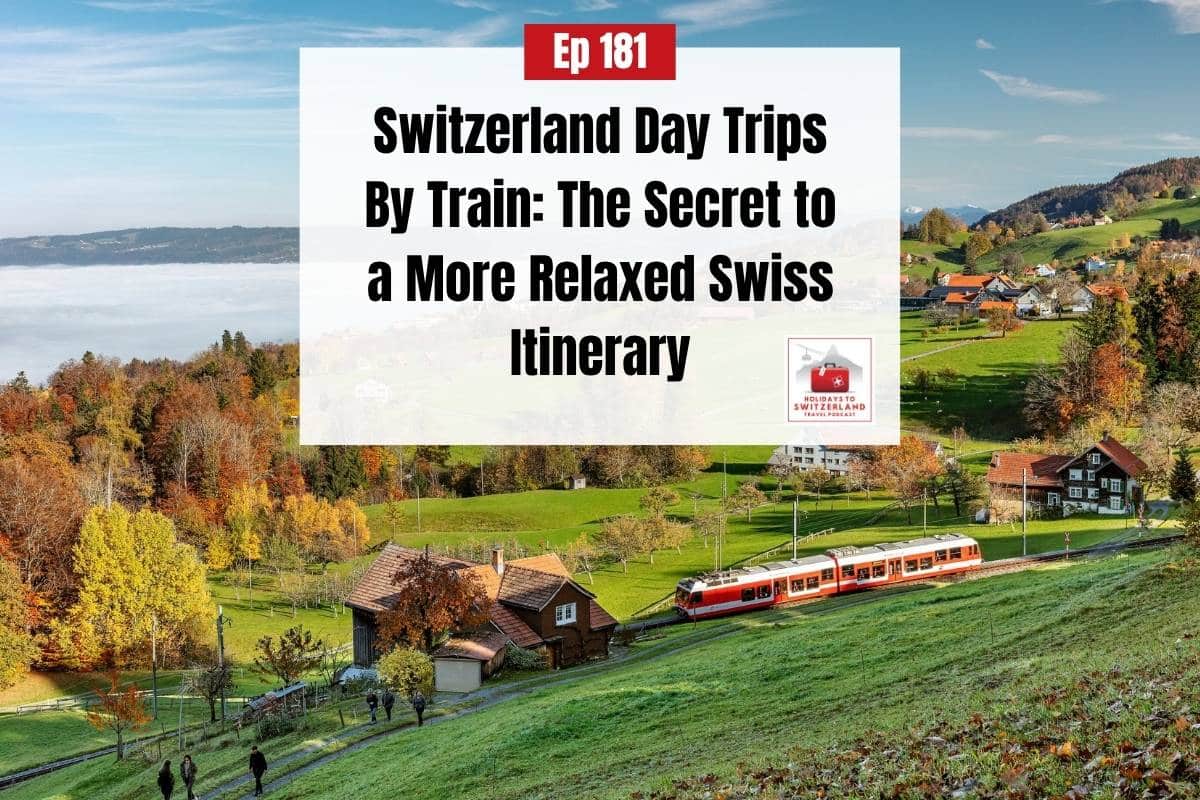
Switzerland Day Trips By Train: The Secret to a More Relaxed Swiss Itinerary
You can see the full show notes and listen to this episode > here.
Carolyn Schönafinger: Welcome to the Holidays to Switzerland podcast. If you’re planning a trip to Switzerland, this is the podcast for you. I’m your host, Carolyn Schönafinger, the founder of holidaystoswitzerland.com and in each episode, my expert guests and I share practical tips to help you plan your dream trip to Switzerland. You’ll get helpful advice about travelling around Switzerland and hear about the most popular destinations, as well as some hidden gems. And we’ll introduce you to plenty of wonderful experiences that you can enjoy as part of your Swiss vacation. Each episode is packed with expert tips, itinerary ideas and inspiration to help make your Swiss vacation planning easy. So let’s dive in. Hello, welcome to this week’s episode. Today, Andy Neff, one of our favourite podcast guests, returns to share his expert insights on discovering Switzerland whilst travelling aboard its world famous public transport network. Switzerland is renowned for its spectacular trains and scenic journeys, but there’s a new trend in exploring the country and that’s using just one or two central bases or hubs and enjoying just day discoveries by train, bus and boat. In this episode, Andy explains why this relaxed, flexible way of travelling is becoming more popular and how it allows visitors to really immerse themselves more deeply in the destinations that they choose.
Carolyn Schönafinger: You’ll learn about the best places to base yourself the advantages of travelling with a Swiss Travel Pass, and you’ll get insider tips to make your adventures seamless and stress-free. Andy also shares some inspiring day trip ideas and his personal favourite Swiss routes, proving that slow travel truly lets you experience the best of Switzerland without the hassle of constantly packing up and moving hotels. So whether you’re a first-time visitor or a returning traveller looking for a new way to see Switzerland, you’ll find plenty of helpful advice and itinerary inspiration in this episode. So let’s hear from Andy. Hi Andy, welcome back to the podcast. It’s been a few months since you were last on the show, but you are a very frequent guest and it’s always great to have you here sharing your knowledge of the Swiss transport public transport system and being so generous with your time. So thank you very much for our listeners who haven’t heard you previously. Could you introduce yourself, please?
Andy Nef: With pleasure. A very good morning, Carolyn. I’m very happy to be here again in your podcast, always a great pleasure and well, my name is Andy Nef and I’m market manager for Swiss Travel System. That’s the company in charge of the promotion of Swiss public transport abroad.
Carolyn Schönafinger: Fantastic. So I know from our previous chats that you just absolutely love everything about trains. It’s a passion of yours. So, as I said, it’s great to have someone with your knowledge and your passion here to tell us all about them. So to get started, is there any news or are there any special events happening in Switzerland this year in relation to the railways that perhaps our listeners should know about?
Andy Nef: Well, there is one thing I would like to mention, and I think I have been talking about that many, many times already about the Grand Train Tour of Switzerland. And you wouldn’t believe the Grand Train Tour of Switzerland is turning 10 years this year. So we are going to celebrate any worse. Right? There will be one or the other event happening around the Grand Train Tour of Switzerland this year.
Carolyn Schönafinger: Okay. So for those folks that aren’t familiar with that, can you just give us a bit of a brief summary of what the Grand Train Tour of Switzerland is?
Andy Nef: Of course, since, how to say, the selection of the variety of beautiful train lines in Switzerland is so big, we have created this Grand Train Tour which includes the most beautiful and the most scenic train trips of Switzerland. Well, there we are. It takes at least eight days to cover the whole tour. But of course, there are also shorter variations of this Grand Train Tour of Switzerland. And yeah, it’s unbelievable. It’s already 10 years since we started that I was quite fresh in the company and I still remember that. And unbelievable how fast at the time is running.
Carolyn Schönafinger: Yeah. Wow. And even though the name includes the word tour, it’s not actually a guided tour as such. You said it’s an independent trip around Switzerland.
Andy Nef: That’s a very important fact. Yes, it’s an itinerary. It’s an itinerary. It’s a suggestion on how to travel on the most beautiful train lines of Switzerland. And however, there are packages available around the Grand Train Tour of Switzerland as well, provided by various tour operators in Switzerland.
Carolyn Schönafinger: All right, so we know that that’s a fantastic way to see Switzerland, and as you said, you’ve talked about it before on previous episodes. But there is a different way to explore the country that’s becoming quite popular, too. And I know Switzerland, tourism and travel. Switzerland refer to this style of trip as day discoveries. So can you tell us more about this style of travel and how it differs from the Grand Train Tour of Switzerland?
Andy Nef: Yeah, we call it the Day Discoveries because there is so much to discover in Switzerland by public transportation. I mean, the big difference is that you stay longer in one place. How to say, Switzerland is such a small country, it’s a compact country and you really don’t lose much time for travelling around in comparison to other countries, of course, and also thanks to the great public transport network we have here. So it’s absolutely possible to stay in one place for several days and then travel from this place to various other place on a daily basis. And that’s actually the secret behind these day discoveries.
Carolyn Schönafinger: Okay, so what do you think are the biggest advantages of using like a single base and doing day trips?
Andy Nef: You’re just decelerating your whole trip. I mean you don’t need to pack and unpack your suitcase every day or let’s say every two days you return to kind of a familiar area, to a familiar place every evening. Just makes it more relaxed on my opinion. And well, it’s a new way of travelling and I’d say Switzerland is the perfect country for that since we have such a good public transport network.
Carolyn Schönafinger: Absolutely. I guess you could refer to it as slow travel really because you’re staying put for longer in a particular destination. So why do you think that this style of travel is becoming more popular? Is there a particular reason do you think?
Andy Nef: Well, I mean we have been working with Switzerland tourism on this for quite a while and the idea behind is actually the travel better campaign of Switzerland tourism. Make more of your holidays, make more of your trip, stay a little bit longer, take it more relaxed, decelerate the whole trip. And I think this is a particular good way to explore Switzerland for repeaters. People who have been to Switzerland already and maybe have been touring the country before and now want to explore certain areas of Switzerland a little bit more and maybe a little bit more profound. I think you are very good example, Carolyn. Yeah, you’re actually doing this already for quite a while, these day discoveries.
Carolyn Schönafinger: Yeah, I must say I do really love that this style of travel now where you can just, you know, set down in, in a one location for three, four, five days and then you don’t have to worry about moving your luggage every day, checking in and out of different accommodation. It really is so relaxing and you become so much more familiar with the place you’re staying in than you would if you were just there for an overnight or even two nights.
Andy Nef: So absolutely, that’s the way. Yes.
Carolyn Schönafinger: Yeah, yeah. So what is it in your opinion that makes a destination a great base for a day trip or is any destination, you know, a good option?
Andy Nef: Well, I’d say in general every destination can be used as a hub. But of course the better connected a destination is, the better it works as a hub. I mean all of Switzerland is very well Connected in a way. But of course some places are better connected than others. There are more remote places, there are more central places, there are places with more transportation lines leading in and out, et cetera. So I’d say maybe for people who are opting for this way of travelling for the first time, a more central location may be more useful.
Carolyn Schönafinger: Okay, so when we’re talking about day trips and these day discoveries, are we just talking about visiting other cities and towns by train or public transport?
Andy Nef: You would miss out so much in visiting cities. Only in Switzerland and there is a whole variety of options. There is cities, of course, there’s various cities, there are many towns, smaller towns which are not very famous yet. But of course then there are lakes, mountains, there are panoramic trains. You can also include sports. You can do a day of hiking in between, enjoy the nature, or maybe just spend half a day somewhere on a lakeshore and swim and relax. There is so many options in Switzerland. And again, I’d say Switzerland is really the perfect country for this way of travelling since how to say that the country is compact and there are so many things to do. I mean, where else can you find snow peaked mountains, palm trees, lakes and metropolitan cities and all within two hours of travelling?
Carolyn Schönafinger: Yeah, not many other places, that’s for sure. So when a traveller has decided on their base or basis, do they need to book their day trips in advance? And what type of ticket or rail pass would you suggest that they buy and for what reason?
Andy Nef: Yes, very important point. I’d say the best ticket is the Swiss Travel Pass. I mean this is our flagship product. It’s the all in one ticket. And this gives you unlimited travelling by train, bus and boat. So basically you hop on and hop off whenever you want. In general, Swiss public transport does not need to be booked in advance. There is a few exceptions. Exception number one is the panoramic train. They need to be booked and they need to be booked far, far in advance. Some of these trains can sell out quite fast, so this is probably the first thing you would need or want to book. Certain mountaintop excursions have become very popular as well. And many of these mountain railways and cable cars provide a pre booking option. So this again, if you pre book your mountaintop excursions, makes just your life easier. So these are really the two things which in my opinion need to be booked and all the rest you can just do how you want and when you want.
Carolyn Schönafinger: Yeah, and with the Swiss Travel Pass, it also includes admission to over 500 museums, doesn’t it? So what Are some of those the highlights of the, you know, the different museums and that people can visit?
Andy Nef: How much time do we have? Exactly? No kidding.
Carolyn Schönafinger: Go right ahead, Andy. Tell us everything.
Andy Nef: No, that. That’s really one fact I love so much about the Swiss travel Pass that, that you have such a variety of added values. You have, as mentioned before, you have the mountaintops, which most of them come at a reduced rate of 50%. Some are even free. And then you have these more than 500 museums nowadays. And don’t imagine typical museums there. There is many historic buildings which are museums. One example here is the Chillon Castle. The most visited. One of the most visited places. And the Chillon Castle is a museum, so it’s free of charge. With the Swiss Travel Pass. There is, of course, many art museums in Switzerland, like, how to say, the Paul Klee Museum, Bern, for example, or the Kunstmuseum in Basel. So there is many historic museums. There is, for example, the Red Cross Museum in Geneva. There is the Olympic Museum in Lausanne. But there is also famous UNESCO World Heritage places like the Abbey Library of Sankt Gallen. And I could go on and on and on. And I think you could actually spend a whole year in Switzerland and visit like two museums every day. Some of them are quite small.
Andy Nef: You don’t need like a day to visit them. One example could be the Matterhorn Museum in Zermatt. I mean, if you have, let’s say, half an hour or one hour left, go and visit it. It’s just giving you some more insights on the local history and the local culture, et cetera. And it’s just an added value.
Carolyn Schönafinger: That’s right. And that’s one of the really great things about the Swiss Travel Pass, because not only is your public transport free, but then you’ve got those admissions. So doing these day discoveries, you know, you could set off for the whole day and you don’t have to put your hand in your pocket except for what you want to eat. So it’s. Yeah, it’s a perfect way to travel.
Andy Nef: Absolutely.
Carolyn Schönafinger: Okay, so can you share an example of one of these Day Discovery itineraries that works really well with the Swiss Travel Pass?
Andy Nef: Yeah, I mean, we have started this campaign, the Day Discovery Campaign, with three, let’s call it partner cities or partner regions. And the three are Interlaken, Lausanne and Lucerne. That’s the cities or the areas we have started with. And there’s more to come. I’m sure that’s just the beginning. And I have now created an itinerary with Lausanne, which is maybe the lesser known city of these three. And I mean, let’s call the first day the arrival day. And most people, let’s say from Australia or from other overseas destinations would probably fly into Zurich airport. Of course some may connect to Geneva as well, maybe from the UK or arriving with a Middle east carrier. And Lausanne from Zurich is. Zurich airport is a little bit more than, yeah, let’s call it two and a half hours. Two and a half hours travelling, meaning you are there before lunch. Actually when you arrive early in the morning, you’re there before lunch. So you check in at your hotel or at least leave your luggage there and then you have the whole day to discover your, your base, call it your base, right, for these day discoveries.
Andy Nef: So get familiar with the environment, find maybe the closest restaurants or whatever, have some sightseeing and the afternoon is all yours. Right. And then on the second day, call it the mountain day. Mountain day. We are going to take an excursion to Montreux and up to the Rochers-de-Naye. I don’t know, have you ever been to the Rochers-de-Naye?
Carolyn Schönafinger: I have been to Rochers-de-Naye, yes.
Andy Nef: All right.
Carolyn Schönafinger: In winter, unfortunately the weather was not great, so we didn’t get the amazing views that I know exist from up there. But it was a great ride up there on the cogwheel train.
Andy Nef: I mean the ride up by cogwheel train is already an experience on itself. But then on a beautiful day, of course you have all the views of the Swiss Alps, the French Alps, 360 degrees view. And you, you have a Marmo’s Paradise up there where you can observe these small little animals, see, harvesting grass for the winter, etc. And then we can go down maybe after lunch and visit the Chillon Castle, which is not too far from the railway station in Montreux. There is a bus going there takes only a few minutes. And then of course with the Swiss travel pass, as mentioned before, the visit to the Chillon Castle is free of charge. We can then still continue to enjoy this special vibe of the Swiss Riviera as we call it in Montreux. Maybe have dinner in a local restaurant in Montreux so that we can avoid rush hour. Rush hour in Switzerland is in the evening, let’s say between 4:30 and 6:30. So dinner, the trains are all yours again. So this would kind of conclude our first day, the mountain day. And you see there’s already quite a variety of different activities we have packed into these days.
Andy Nef: But believe me, you wouldn’t be too busy, even though you will experience two or three different kinds of attractions in the area.
Carolyn Schönafinger: Right.
Andy Nef: And then day number three, we could call the city Discovery Day. For example, we could take a trip to Bern. Bern is only 1 1/2 hours from Lausanne and there is a train every 30 minutes going to Bern. It’s an intercity train again. Maybe leave after 8:30 in the morning so that you can avoid rush hour. And then in Bern you can visit the Old Town, which is a totally different kind of Old town than the one in Lausanne. For the ones who have been to Bern already, remember it’s UNESCO World Heritage beautiful medieval town with loads of restaurants and there are these special arcades as they call them, with lots of boutique shops, small restaurants and etc. But of course you can enhance your stay with a visit to the Paul Klee Museum. So add a little bit of art, add a little bit of culture, and then we can travel back on a different line. We can travel through Biel/Bienne and use a different railway line down to Lausanne so that we have two different kinds of of views from the train.
Carolyn Schönafinger: Great idea.
Andy Nef: Yeah. We can still stop by the way, on the way back we can stop in one of these beautiful villages in the wine area of the Three Lakes area and maybe have some local wine and some traditional local dishes there before we head back to Lausanne. The trains are running until about midnight, so no problem at all.
Carolyn Schönafinger: Okay, well that’s great.
Andy Nef: And then, well, if we are staying on a four day Swiss travel pass, we have reached the end of our stay already. But I think, yeah, well, we could head back already. Head back to, let’s say Zurich Airport or whatever. And if there is an afternoon or evening flight, we can still travel in a special way back by travelling on the Golden Pass line, for example. Or then of course we can combine the day Discovery destination of Lausanne with our next day Discovery destinations, which in our case would be Interlaken. So instead of, well, finishing our day Discovery experience in Switzerland after four days already, we just add a second destination and that this could work perfectly. With an eight day pass, we would arrive by Golden Pass express from Montreux. That’s only a three hour trip. So if you leave at 9 o’ clock in the morning, we would reach Interlaken just for lunch. And so that gives us again time to accommodate ourselves to get familiar with the area. Maybe there is in summer there is even time for going up to the Harder Kulm. That’s the local mountain excursion it takes only a few minutes to go up there.
Andy Nef: There is a nice restaurant up there with a huge terrace which provides beautiful views over to two lakes which give the name to Interlaken. Right. And Harder Kulm, by the way, is 50% with the Swiss travel pass.
Carolyn Schönafinger: Okay. And great for the sunset views up there too, so.
Andy Nef: Absolutely.
Carolyn Schönafinger: If the weather’s good, it’s unforgettable, the views from up there.
Andy Nef: Yes, totally agree on that. And then again, the second day of our arrival, we could do a mountain day again. And of course there are countless mountains, countless mountains in the area of Interlaken. Is it, for example, an excursion to the Schilthorn? I mean, they have introduced a new cable car. It’s the steepest aerial cable car in the world. And it’s quite spectacular, I have to say, even for me, who has experienced a lot of cable cars already. First, the first part would be up to Mürren. Mürren is a car-free mountain destination, quite nice. You can walk through the town and there’s a lot of restaurants there, etc. And then head up all the way up to the Schilthorn Piz Gloria, famous for one of the James Bond movies they have made up there in the 60s. There is still time to visit the Trümmelbach Falls on the way back, the famous waterfalls which are more or less inside a mountain. And well, we would be back to Interlaken for dinner, right?
Carolyn Schönafinger: Yeah, that’s a great day. And I would encourage people to enjoy the delicious brunch that’s available at the revolving restaurant on the Schilthorn summit too. So that even adds to the experience even more.
Andy Nef: Totally agree. And then, well, one more day is over. So let’s focus on the next day, which could be our lake and museum day. I’d say why not take an excursion by boat on Lake Thun? Well, there is. In summer there is a paddle steamer operating a historic paddle steamer at the Blumlisalp, that’s the name of this paddle steamer and takes about two hours to go by boat to Thun. But don’t worry, there is an onboard restaurant on the boat so you can have your apero already. You know, we Swiss, we love apero. So we can have maybe a glass of local white wine already and enjoy the beautiful sceneries passing by. Once we arrive to Thun, another beautiful medieval town. I used to live there for 10 years and I really loved it. I really loved this place. And we could have some lunch in one of the local restaurants. There’s many different kind of restaurants in the old town. And then we can visit the Castle of Thun. And the Castle of Thun is on a hill overlooking the city. And of course it’s a museum. So free of charge with the Swiss Travel Pass.
Andy Nef: And again have maybe dinner in the old town of Thun to avoid rush hour on the way back to Interlaken, which is only a 30 minute trip by train. And trains are running every 30 minutes. Intercity train. Yes. And then we have one day left. I’d say before we have to leave, let’s do another city. Discovery Day. And I’d say Lucerne could be a very good option out of Interlaken. That’s a two hour trip on the Lucerne Interlaken Express. And the Lucerne Interlaken Express is one of our panoramic trains. They are run every hour. And what I like about Lucerne Interlaken Express, it, it doesn’t take too long. Two hours are totally manageable. But still you get beautiful views. You are travelling along five lakes and all these lakes have a different colour. That depends on the amount of minerals in the water. And Lucerne, well, again beautiful medieval city. Medieval town, the old town. Many restaurants along the Reuss River. There is a lot of culture as well. There is the Picasso Museum for example, free of charge with the Swiss Travel Pass. And there is the Swiss Transport Museum which I like very much.
Andy Nef: As you know, you can see all these old locomotives and trains. But it’s not only trains, it’s all about transport. So you learn about Of course there’s aircrafts, boats, ship, et cetera. And you get a 50% reduction with the Swiss Travel Pass there. And you can still travel back on a On a different line. You can travel back through the Emmental. That’s where the famous cheese is coming from. Right. That’s more like the Pre Alps. Think of rolling hills and the train is passing through meandering valleys. And there is a place called Trubschachen in between where you find the Kambly factory. And Kambly, that’s one of the most famous Swiss biscuit brands.
Carolyn Schönafinger: And very delicious they are too.
Andy Nef: And right next to the railway station is the factory shop and the Kambly Experience where you know all about these biscuits. So this would be a full day of experiences. All different kinds of experiences. Yeah, that’s more or less the conclusion of our day Discovery trip to Switzerland.
Carolyn Schönafinger: Yeah, that’s right. Because on the, on the next, on day 8 of an 8 day Swiss Travel Pass, we would return to Zurich airport or wherever we’re departing from.
Andy Nef: There we are. But of course you have still the option to stop somewhere in between depending on when your flight is actually leaving.
Carolyn Schönafinger: Yeah, I mean you’ve included so much variety in that eight day itinerary. It just really shows people how much you can actually see and do in a short space of time and with. Without having to move hotels every day or every. Every couple of days.
Andy Nef: Yes, absolutely.
Carolyn Schönafinger: So I, I’m pretty sure that the flexibility of this style of travel will be really appealing to many travellers. So once they have their Swiss travel pass, you mentioned that it’s a hop on, hop off kind of ticket, how do they actually use it to travel on the trains and buses and boats, do they need to scan or validate their pass before boarding?
Andy Nef: Not at all. I mean public transport in Switzerland is barrier free. It’s not like for example in the UK where you have to scan your ticket, where it is a barrier you have to pass for getting access to the trains and there is a conductor on the trains which is checking your pass. That’s on the intercity trains. On local trains there is no conductor at all. But of course there is random checks and. Well, should you be on a train without a ticket? Can be. Oh, it can get rather expensive. Yes, there we are. So the only pass you actually have to validate is the Flex Pass, the Swiss Travel Pass Flex always needs to be validated or the day needs to be selected the day before departure.
Carolyn Schönafinger: Okay, all right, that’s good to know. Now, I think people who aren’t regular public transport users at home are sometimes a bit apprehensive about relying solely on public transport to travel around Switzerland. So do you have any tips to help them travel with confidence?
Andy Nef: Well, first of all, it’s a Swiss way of travelling. We use it every day on average. Just to give you an example, on average, Swiss Federal railways are transporting 1.4 million people a day and 95% of these people are Swiss. We use it public transport on a daily basis. We are world record holders on train travelling. That’s a fact really. I don’t make it up. So this is a Swiss Way. That should already give you confidence in travelling by a Swiss travel pass. But then of course there is also help, and help can be the Swiss the SPB mobile app, which is really your timetable in the pocket size timetable. Right. You load it down on your mobile phone and you get access to real time timetable and it’s covering all public transport even though it’s provided by the Swiss Federal Railways, it includes all public transport of Switzerland. Then another thing which should really help you to Understand, the Swiss public transport is our regular interval timetable, meaning there is a train on the main lines every 30 minutes. And since we don’t need to book seats, we have the whole, the full flexibility.
Andy Nef: If we miss one train, if we miss a connection, we just take the next one, don’t you worry, Have a coffee at that coffee shop in the station, take the next train. And then last but not least, there is a lot of friendly people in Switzerland who are very eager to help. Even though we have four official languages in Switzerland and English is not among them, we do speak English. Most people in Switzerland do speak English. So don’t you worry, there is. I’m sure you will find somebody to help you should you get lost or should you be unsure?
Carolyn Schönafinger: Yeah, absolutely. I have had times where I’ve needed to request help or I’ve done something, you know, I’ve mixed up the times or whatever, and there’s always been someone there who’s been very, very helpful and, yes, willing to help me sort out my mistakes. Now, speaking of mistakes, in your experience, what are the biggest mistakes that travellers make when they’re planning day trips by public transport in Switzerland?
Andy Nef: Yeah, well, don’t overload your itineraries. I mean, even though Switzerland is small and public transport is perfect and you don’t lose much time for travelling from one place to the other, there is still a risk to overload your itineraries and make sure that is enough time to indulge into the Swiss lifestyle. For example, I mentioned before, we Swiss, we love Apero having a drink before lunch or having a drink before dinner. A glass of white wine, sit back, relax on a terrace, enjoy the fresh air, have a glass of white wine, wind down before you go for dinner. That’s the Swiss lifestyle. That’s the Swiss way.
Carolyn Schönafinger: Yes, and yes. Why not incorporate that into each of your day discoveries.
Andy Nef: There we are. Absolutely a must, in my opinion.
Carolyn Schönafinger: Yeah. Now, one of my favourite day discoveries was when I visited the charming town of Murten. We were staying in, I hope I’m going to pronounce this right, Yverdon les Bains, in the western part of Switzerland. And we took a train there to Murten, and then we took a boat ride back to Neuchatel. That’s part of the, as you know, Andy, the Three Lakes region. It was just a really, really great day. We had the train ride, the visit to the mediaeval town with its castle and beautiful views, and then cruising back from one lake to another back to Neuchatel, which was just amazing. So is there a day trip that you’ve done that is a personal favourite.
Andy Nef: Well Carolyn, I have to say what you just mentioned, that’s the perfect example of a day discovery. This can be done out of Bern, this can be done out of Interlaken and it can even be done out of Lausanne, what you just mentioned. Well, you know that my heart beats for eastern Switzerland and in my opinion area which is still on off the beaten track. And one of my favourite day discoveries would be to discover the Toggenburg and Appenzell. And this can be done for example, out of Lucerne. From Lucerne there is well a lesser known panoramic train, the so called Voralpen Express. Voralpen means pre Alps. And this train is going to through, well more like the rolling hills. And there is a lot how to say, the train follows these valleys where you find the meandering river and well that’s my home turf. So there we are. I was brought up in the Toggenburg valley, one of these valleys where the train is passing through. And after not even two hours you would reach, well, it takes maybe one and a half hours to a place called Wattwil. That’s where I was brought up.
Andy Nef: And there you can change and head up to Mount Sentis by local train and bus. And Mt. Säntis is the highest peak in that area. It’s not one of the highest mountains with 2,500 metres, but it gives you a perfect view across three countries and well, actually four to be precise. And always forget Liechtenstein. I’m really sorry. And it doesn’t take too much time to go up there. And on the way back we take a different route. We are going down through Appenzell. There is a private railway called Appenzeller Bahnen which of course is included in the Swiss Travel Pass. And by the way, the Säntis Cableway is 50% with the Swiss Travel Pass. And in Appenzell you find a lot of local culture and of course also local specialties like siedwurst, which is Switzerland’s or up and sales answer to the Weiss. We are stay in Germany and then you can head back through St Gallen for example to Lucerne. So this would again be a perfect day discovery exploring the east of Switzerland.
Carolyn Schönafinger: There’s just so many options, isn’t there? As you said at the start, from wherever you are in Switzerland there’s endless opportunities to explore for a day trip. So in your opinion, why is choosing just one base or perhaps two bases and planning day discoveries a great way to experience Switzerland?
Andy Nef: It just makes your travelling in Switzerland better, that’s all I want to say. I really. It makes it so much easier in my opinion. But yeah, it’s a different way to approach it, a more relaxed way. And still you can see so much.
Carolyn Schönafinger: Yeah, slow travel without missing out on anything.
Andy Nef: Perfect. Yes. That’s the wrap up, I’d say.
Carolyn Schönafinger: Well, thank you, Andy. It’s been really great chatting to you again and look forward to chatting again soon and you bringing us more wonderful insights and ideas about travelling by public transport in Switzerland.
Andy Nef: Always happy to be here. Thank you.
Carolyn Schönafinger: As you’ve just heard, there are so many wonderful ways to experience Switzerland by public transport. Whether you choose to follow the iconic Grand Train Tour of Switzerland or embrace the increasingly popular Day Discoveries approach and uncover the beauty of Switzerland using just one or two bases. Thanks to Andy’s tips, I hope you now feel more confident about choosing your own travel style and confident about getting around Switzerland by public transport. To help you get started with planning your own day Discoveries or Grand Train Tour Adventure, I’ll include links to the Swiss Travel Pass and all the destinations and experiences that Andy chatted about today. In the show Notes for this episode, you’ll also find a link to the Grand Train Tour of Switzerland, rail packages that Andy mentioned and our exclusive promo code that entitles you to a 5% discount. The show notes can be found at holidaystoswitzerland.com thank you so much for joining me today. If you know someone who’s planning their own Swiss adventure, please share the podcast with them. I’d be super grateful. Until next week when I’ll be back with more Swiss travel tips and inspiration. Tschüss.
You can see the full show notes and listen to this episode > here.
